From five people in a broom cupboard to 38 staff across Western Australia, Consumers of Mental Health WA has spent 20 years advocating for systemic change in mental health services.
Mark Davis sat down with Dr Mad Magladry, Deputy CEO and Advocacy Manager, to talk about what lived experience leadership really means, why co-design is more than consultation, and how they're filling the gaps the system creates.
“The reality is, many people have a lived experience of some kind. If we had supportive practices for everybody, we’d all benefit.”
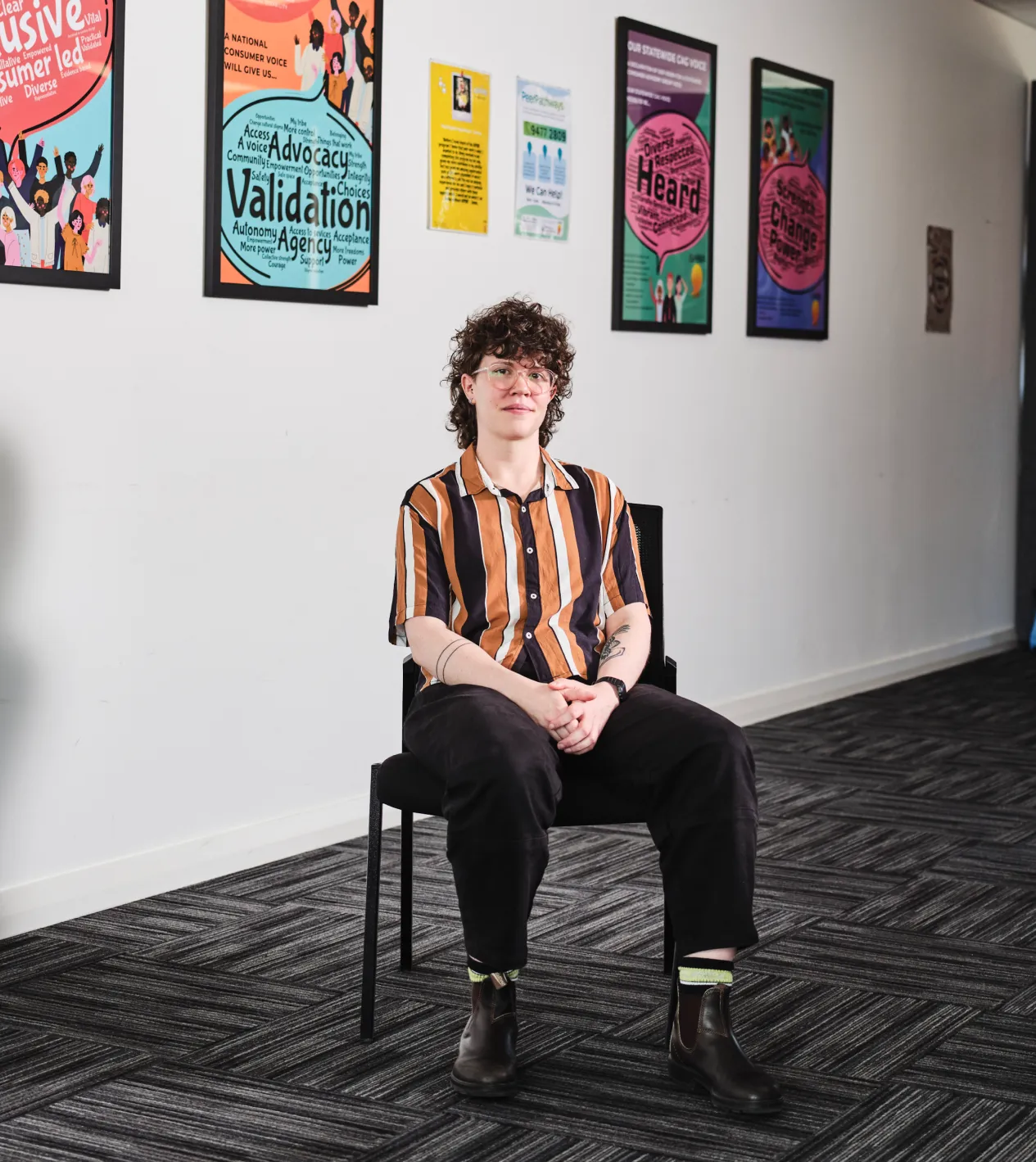
Dr Mad Magladry, Deputy CEO and Advocacy Manager, Consumers of Mental Health WA, they/them
Mark Davis, National Partnerships Director, Today, he/him
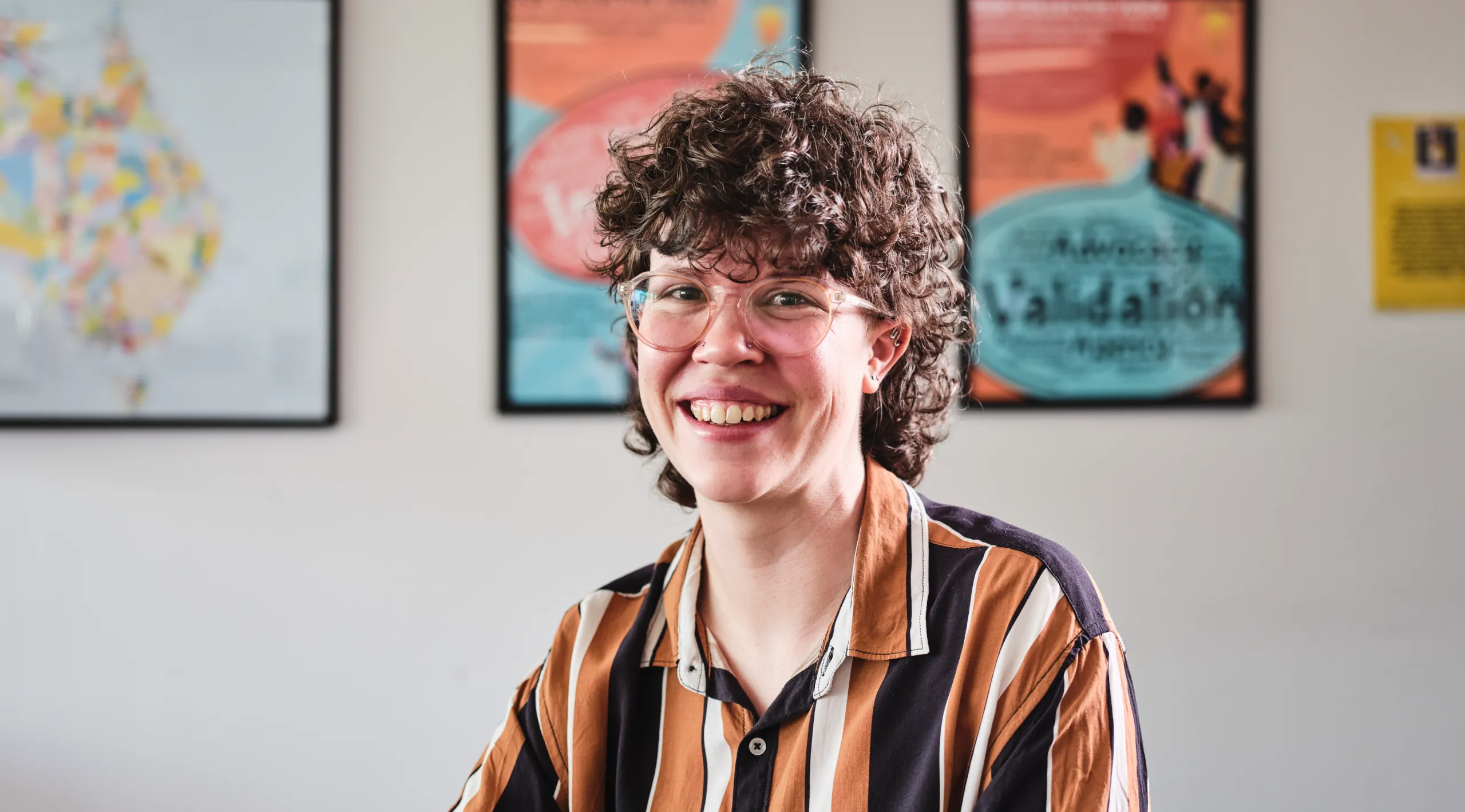
Thanks for taking the time to chat today, Mad. You’ve been at Consumers Mental Health WA (CoMHWA) for over three years now. Tell us about how you got here.
I started my career as a casual academic. I did my PhD in cultural studies, with a particular interest in feminism and fitness spaces—we can get into that later. But I was working as a sessional lecturer and research assistant across two different universities, and I had a mental health crisis about five years in. I had to step back from my work completely, and I realised I needed a career change. I was not sure at all what to do. Academia doesn't exactly prepare you to think about how to apply your skills to other industries. So initially, I was really lost.
I was working in retail at the time. I applied for a peer work skill set training course that CoMHWA offered as part of our training, and I was thinking, you know, I would love to be able to use my experience in the mental health system—the hurts and the harms and helps of the system. I would love to use that experience to connect with people. So I applied for the Peer Work skill set.
The people here found out that I had a PhD and asked me to write some conference papers. I started working at one of the services I was about to write a conference paper about, and from there, I got involved in the systemic advocacy program, which is amazing because I did not know that was a job you could do. So it was quite lucky to find a path here.
What is CoMHWA’s role in the system at the moment?
CoMHWA’s place in the system is interesting. We started 20 years ago as primarily a systemic advocacy organisation—writing submissions, giving feedback to the government, and asking to be involved in decisions made about us. And this was a real grassroots movement, you know, five or six people around a coffee shop table, and then gradually in bigger spaces, but always broom cupboards in the beginning.
In the last 10 years, we’ve really expanded, and in the last three years, we’ve expanded towards service provision. But the services we offer are not “how to get better, how to be well”—they’re often meeting and looking at addressing gaps that the system has created. So they come about through our systemic advocacy in a lot of ways.
For example, Peer Pathways is a phone line service navigation program. And what we’re hearing, and what we continue to hear all the time, even with Peer Pathways, is that the system is too hard to navigate. If I need help, I have to do all this work to find out what services are available, who’s eligible, how much it costs, what the waitlists are like, do they meet my needs—my intersectional needs—and when you’re already unwell, that’s really hard to do. Ideally, the system would not be difficult to navigate in the first place, but we come in and fill that gap.
And some of our other services are about meeting that need where people find it difficult to have their rights upheld, or difficult to have their needs heard or met.
Another example is the Collaborate to Connect (C2C) workshops that offer co-design training to organisations. We were in this position where we were hearing people use the word “co-design” when what they were delivering was really consultation. And we were advocating to them, “Hey, you need to learn what authentic co-design means. You need to deliver it in a way that is really safe and meaningful for people involved.” But we did not have a WA-based consumer-led training to teach them that.
We knew of a couple of services over East that maybe weren’t led by lived experience specifically, but we wanted to make our own so that we could give people a direct action out of our advocacy. So when we say “you need to learn what co-design is,” we can say “go to C2C.”
We saw a need for this service and then applied for funding to make it a reality. The real gold standard is ongoing funding for programs that work rather than having to ask for money for new pilots over and over again. And while we are absolutely grateful for the funding that we have—and it allows us to be flexible and create new projects—we definitely see the need for ongoing funding. Once a program has proven that the concept works, people are using it—like with C2C—why not keep funding it by the same people who run it?
100%. Tell me about the people at CoMHWA.
We've got 38 staff members. Many of us are part-time, and flexibility is really important to us in terms of working conditions, so we make that available to anyone who wants it or needs it.
We have ten managers managing ten different programs. Along with Peer Pathways and C2C, we have our core training and education team that manages sponsoring our Cert IV in Mental Health Peer Work placements and our peer work skill set. Some of it is recovery skills like coping skills, and then sessions learning how to navigate the system, and learning how to become a consumer representative, so using your lived experience to make change at a bunch of different levels.
We also have training called ASPIRE that provides people with a taster of the peer work training they might get if they did a Cert IV. It's a lot shorter, and they get an 80-hour work placement in a peer work role. It’s awesome.
And we have a team devoted to empowering and building up the peer workforce. They deliver training to managers and HR in organisations that are considering having peer workers, and ensure their organisations are ready to have peer workers. Because it’s really not just a case of dropping a peer worker in. You have to set them up for success, or you’re setting them up for failure.
You have to set them up for success, or you’re setting them up for failure.
Dr Mad Magladry
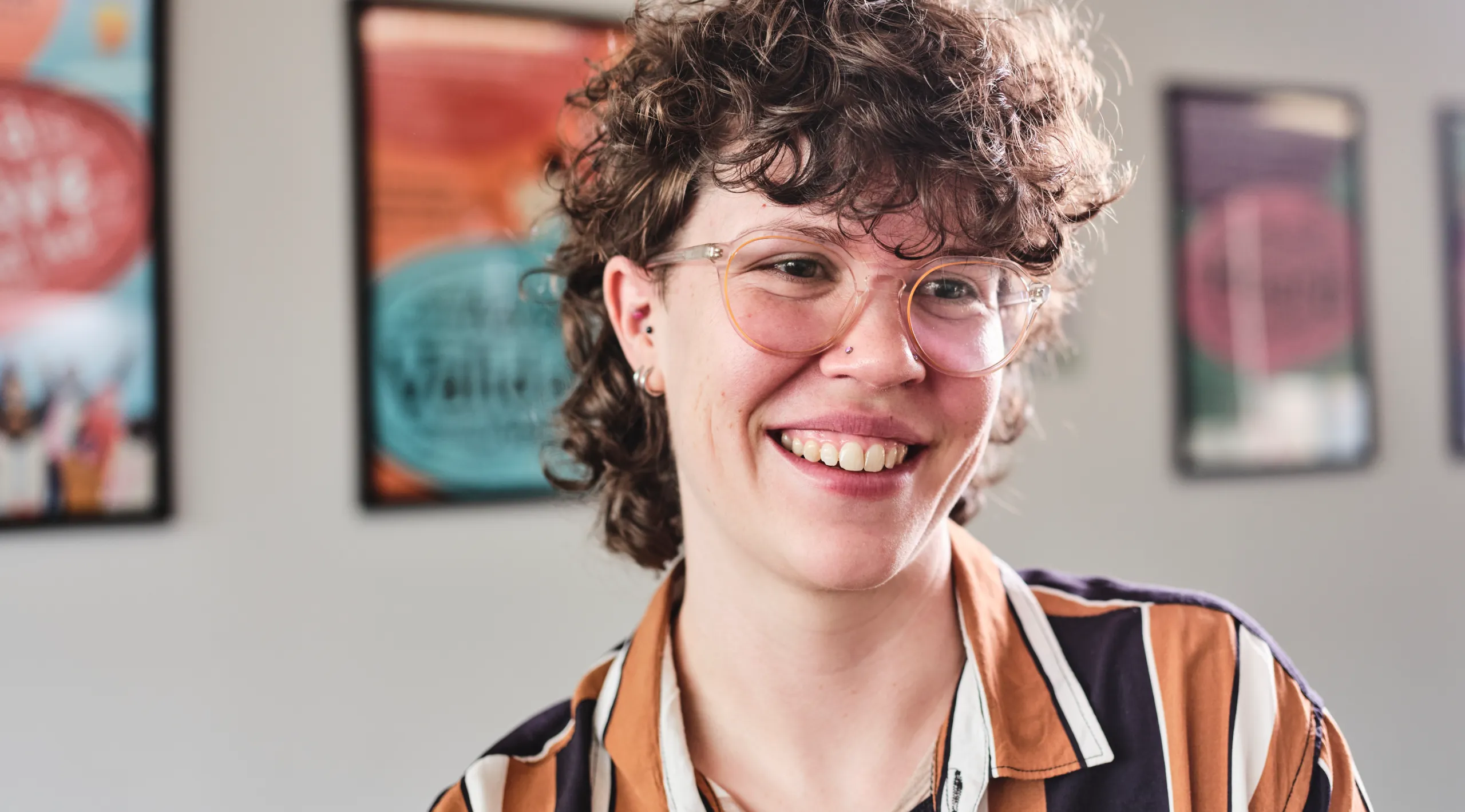
Talk to me about setting people up for success. What does that look like?
One of the big issues that peer workers face—especially when entering a space that hasn't had peer workers before or maybe a clinical setting—is that no one else is sure what peer work means. So peer workers can end up being sent to get coffee or do errands, or they can be sent to take on tasks that a clinician might do—like ensuring someone takes their medication, which is not in line with the values and skills of peer workers.
So by going into organisations and giving examples of what a good, clear job description framework looks like, what role clarity really means and why it's so important, we can demonstrate to organisations that you really need to prepare for this and you need to bring everyone on board. It's not just a matter of saying, “Okay, this clinician is going to manage the peer worker, we’ll have to talk to them about what a peer worker is.” It’s about the people that they’ll be in contact with, and the whole system around them.
Another really important thing that often gets overlooked is career development for peer workers. Peer work can be an entry-level position, but lived-experience leadership at all levels means it must go all the way to the top. So, beyond just service delivery, there needs to be coordination pathways or other leadership opportunities.
Mad, you’re in a leadership role in an organisation where your members are also the people most affected by the systems you’re trying to change. I’m curious what that means for decision-making from your point of view. If you decide as an organisation you want to effect change here—like C2C or something similar—how do you bring people on to that?
One of the big ways we make decisions as an organisation is by thinking about what is important to the movement. So, Consumers Mental Health WA comes from the consumer-survivor ex-patient movement, which is much bigger than us, but it also has very important foundations and learnings throughout the movement. So we do have a blueprint for decision-making.
Democracy is essential to us, as you’ve hinted at. When we do make decisions, it’s drawing from what we have been told by our members, what we’ve heard from people. But it’s also important to remember that every single staff member at CoMHWA is a person with lived experience and is connected to the movement. So we’re not just making decisions because our members tell us to do the things—we are all aware of, have experienced and are connected to the movement.
So what that looks like in practice is we have six advisory groups that report to our systemic advocacy team alone, and then we have advisory groups for most of our other services—like C2C, My Voice My Rights My Way, and Life Launchpad. They’ve all been co-designed by our members.
We also have advisory groups that speak to particular systemic issues, like and NDIS reference group that's made up of all NDIS participants that can give advice on a really rapidly shifting landscape.
We meet with those people monthly, we ask them about what they would like to see us do, and we get feedback on positions that we’re already taking, and our strategic plan itself was co-created by staff, board members, members—it’s really in the DNA.
It feels like it!
Do you still think of yourself as an academic? I ask because there is a very robust conversation between the lived experience space and the traditional evidence space. Do you ever see that kind of tension around direction or drive?
I definitely know what you mean, and I know that there’s some really great work happening in some of the tertiary institutions where they’re connecting people with lived experience and academics to try to get a better idea of research translation for people with lived experience, but also to make sure that people with lived experience are involved directly in the research. I know there’s the ALiVE Centre—one out of Melbourne—that does a really great job of bringing lived experience and academics together, and also introducing people with lived experience to academia.
And we’re gradually seeing more lived experience academics in their own right, which is fantastic.
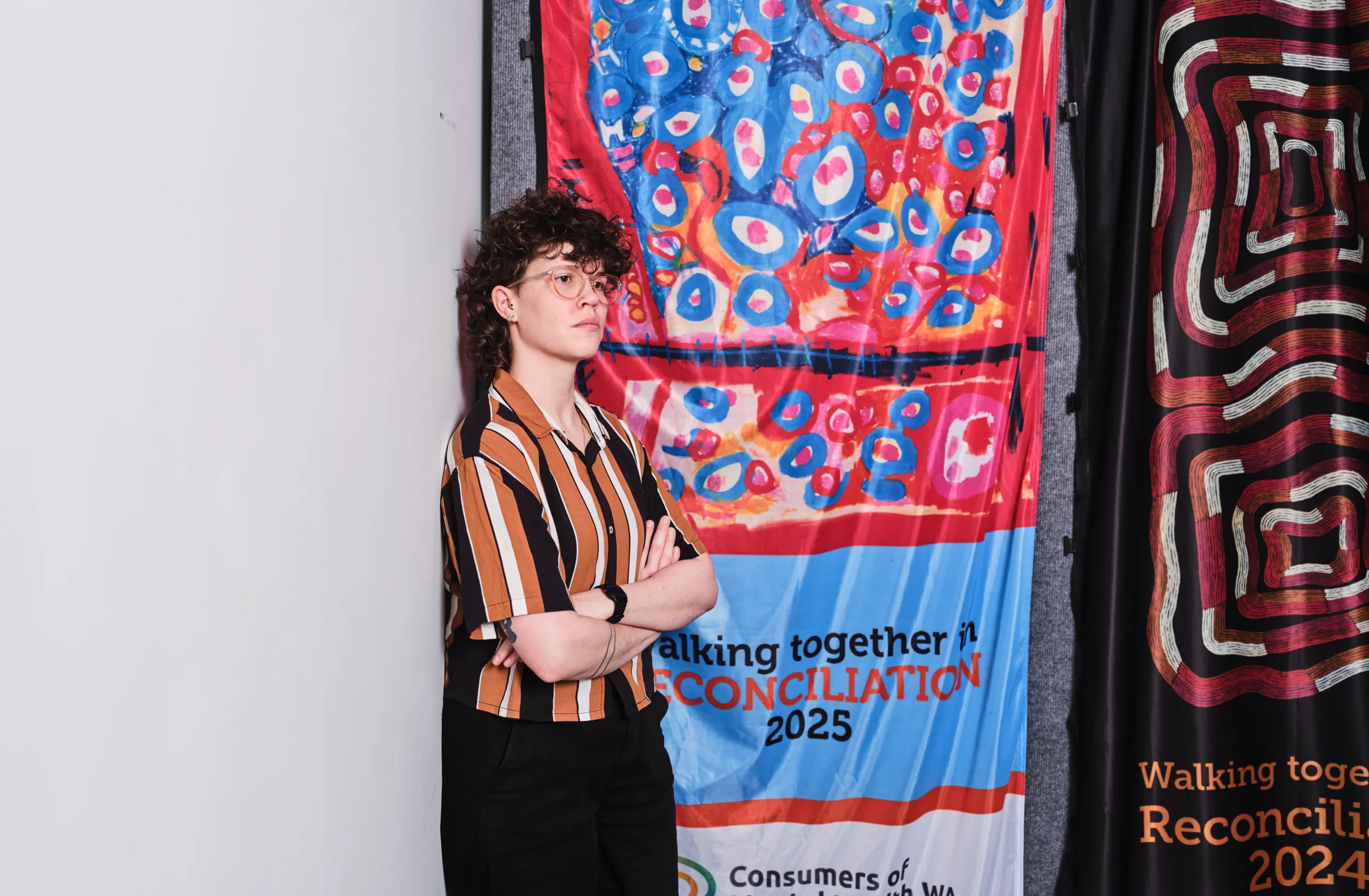
The 20-year history of CoMHWA and its grassroots origins is quite a wonderful story. Stepping back from that, is there a moment of pride or an insight where you go, “Oh, that wouldn’t be there without this organisation or having come through this path”?
It's tough to measure impact. We’re asked by one of our funders to report on the outcomes of our systemic advocacy, and every six months we have the same conversation. Darren likes to say, “We are planting seeds of trees that we’ll never sit in the shade of.”
So there are a lot of things that I think I’m not going to see direct action from in some cases while I’m alive, although I hope to, and I do have hope that we can.
But there are a lot of things that were started a lot earlier that we take for granted now or maybe don’t see as, “This is huge and this is because of CoMHWA.”
A big example of that is how big we are. You know, 20 years ago, it was five people in a broom closet, and now we’re 38 people in almost the full floor of a building. We have funding sources from all over the place, from people who acknowledge the importance of our work and the value of our insight.
Which is an important sign of need and value, isn’t it—multiple funding models and streams.
Absolutely. When we get small pockets of funding to do a particular project, it’s a tactical win, because not only can we deliver the project's value, but the larger ripple effect is that it allows us to grow as an organisation by going out to the regions, for example. Some of the project funding has allowed us to get a regional engagement plan underway and to make concrete plans to visit each region up to twice a year, which, over time, has made us the state peak body.
So I think that’s a big win. And with that advantage in being able to go into the regions, that has allowed us to speak to the Mental Health Commission about the challenges that people in specific regions are facing, which we did recently with the WA suicide prevention framework.
Three years ago when I started we maybe visited Bunbury and Albany occasionally—now we’re going to Esperance, Carnarvon, and Port Hedland. It’s important to mark these changes even if they don’t feel significant when you’re in the middle of them. There’s always more to do, but it’s important to stop and look back and say, “Look at what we’ve done.”
What does lived experience leadership look like to you? What does it feel like operationally versus working in an organisation that doesn’t hold that value as well?
This is really interesting because I think that you’re right that a lot of organisations find this challenging because they’re thinking “us and them”—they’re thinking of “me without lived experience and you with lived experience.” The reality is, many people have a lived experience of some kind. And if we broke down that barrier and went “Okay, we all have things going on in our own lives,” the things that are offered for people with lived experience—for example, peer supervision or wellness leave or even just acknowledging that people might need more flexibility at some times than others around their working conditions or the kind of workload they have or the kind of work that they do—if we did that for everybody, we’d all benefit from it, even the people without—“lived experience.”
We see organisations put in these things for people with lived experience that could be beneficial to everyone, but they don’t.
Today is a very values-driven business. I’ve been in this business for seven-odd years, and prior to that, I had more traditional agency experience, and one of the biggest differences I see in such a values-driven organisation is the tenure. People seem to stay a lot longer because you care about the work, and you have either a personal experience or a drive to work in these spaces. Does that apply here at CoMHWA?
100%. No one’s here for the money. We’re all here not just for ourselves but for the people who are most affected by the mental health system, and we all share purpose and values. Our values are not just a thing that we write down. We commit to them every meeting, and they’re also just unspeakably woven into everything that we do. So it’s pretty hard to get away from them.
I think having a shared purpose gives people meaning in their lives. And for me that was a really big thing that I was struggling with when I burnt out. I was thinking things like, “I’m teaching people, they’re moving on really quickly. I’m writing papers that will probably not have impact for a really long time. What am I doing? Like, where’s the impact?”
And once I got out of that and moved into this job, my own wellbeing was just so much better as a benchmark because I was doing something that made sense to my life.
I think having a shared purpose gives people meaning in their lives.
Dr Mad Magladry
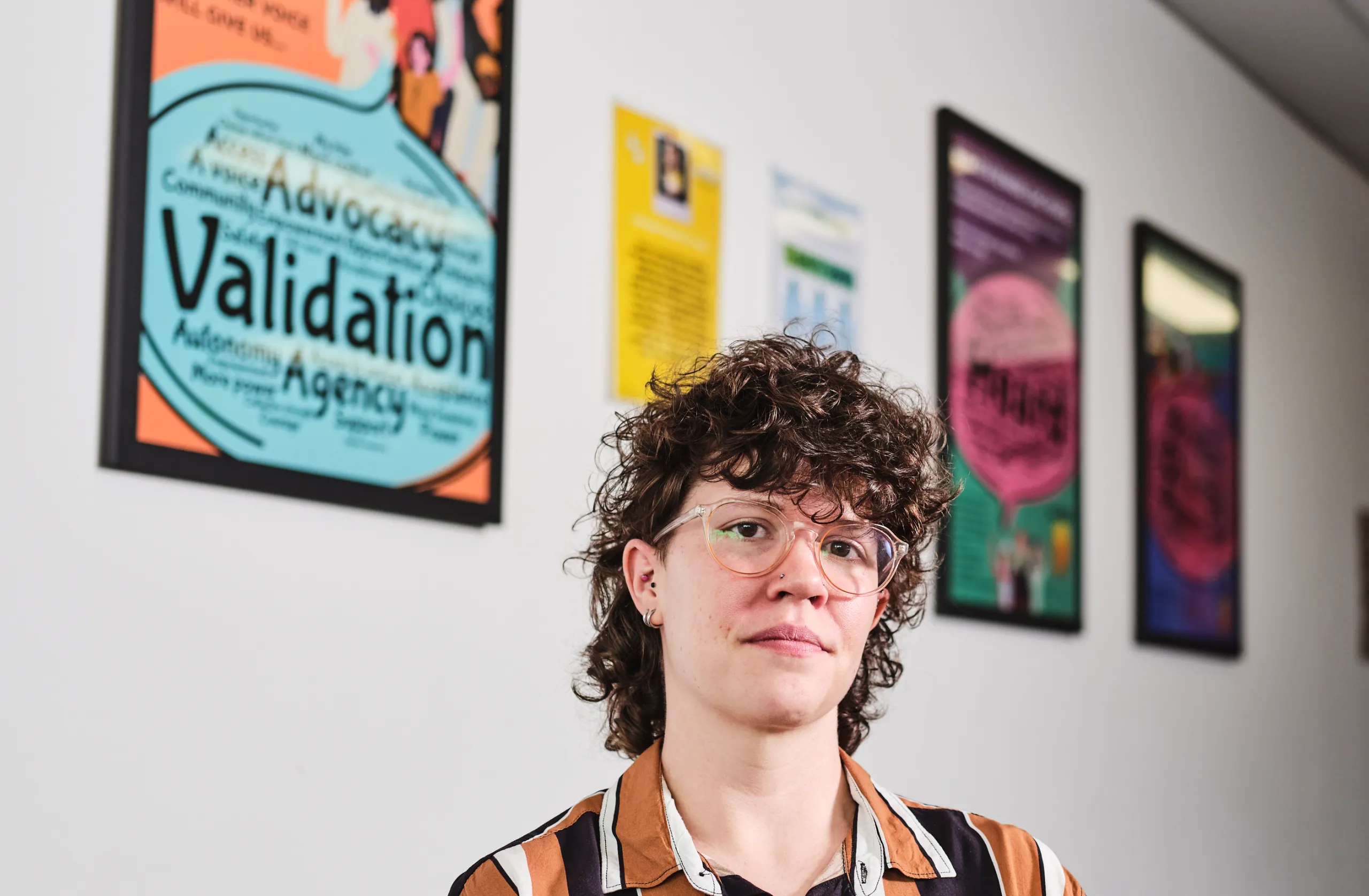
How do you describe the feeling of working here at CoMHWA?
Collaboration is a really big part of our organisation. When we got bigger we had a lot of conversations about, “How do we stay connected to each other? How do we make sure that I can help your team and you can help my team?” Working in universities, you never have that conversation.
So I think the fact that we’re even able to say, “We're really worried about this siloing” shows that we probably don’t have as big of a problem with siloing as we think we do.
I see that every day. Someone is always helping on the phones, we’re always helping each other in our various projects.
We come up against some pretty hard stuff—either the individual advocates having hard cases, people having difficult calls with people who are experiencing really hard things, or our systemic advocacy team getting exhausted by the pressures of the work or being burnt out over the large systemic changes we want to make. But we’re always able and willing to have a chat with each other, to debrief, and to support each other. I think that’s really important.
In this period of growth, do you get worried about losing sight of the intent?
We stay connected to our members, and that really allows us to grow with intent. It’s kind of a reciprocal effect. One of our recent initiatives is to start going into hospitals and mental health wards, talking to people about CoMHWA. Through that, not only are we able to tell people about CoMHWA services so that they can use individual advocacy, but we’re also making more connections to loop those people in to give feedback for our submissions.
Our engagement person takes paper surveys for the consultations that we’re doing and drops them into wards. And when you’re in a ward, you don’t really get asked your opinion on a lot of things—life kind of takes a break. We stay connected through that process.
What are the biggest barriers for your work? Who’s pushing back?
It's really hard to think of that in black and white, because we don’t have people standing at the gate and saying, “no, you can’t come in.” I think it’s a lot more grey.
Most places are willing to have a relationship with us, and the barriers almost seem less connected to a person or a particular place. An organisation or agency will ask us for our input, we’ll give a really great submission, and then things won’t be implemented—not because the man with the money is saying no. There is no single man with the money—it’s a really big connected network of things. But for whatever reason, because the system is too deeply embedded, because the things we want are too ingrained as natural and normal, and the culture hasn’t changed yet.
It’s tough to point to any one person or place and say, “That is responsible for the culture, and we need to change this guy’s mind.” And that’s why relationships are so important. As long as you get people to see you as allies and working together, you can start chipping away at that culture a lot more, rather than taking an adversarial approach.
I’m still thinking about your comment about lived experience, that everyone has lived experience to contribute, but defaults to not including themselves.
That's a cultural thing as well. That’s about stigma and how we’ve internalised it as, “I don’t have a ‘lived experience’ because I’m not that unwell.” But we’ve been told a particular narrative of what unwellness looks like. Well, who defines that and why, and what is the agenda?
In the mental health space, there’s a very singular idea of what it means to be well, and it is a personal responsibility and not a social one. And that opens up massive cans of worms and hides systemic failings and cultural problems. I’m really interested in that and how power moves.
I believe that you’re not worse or better; sometimes you just need more help.
In the mental health space, there’s a very singular idea of what it means to be well, and it is a personal responsibility and not a social one. And that opens up massive cans of worms and hides systemic failings and cultural problems. I’m really interested in that and how power moves. I believe that you’re not worse or better; sometimes you just need more help.
Dr Mad Magladry